
Restaurant owners are more than used to operating under pressure. Unfortunately, that also means most restaurant insurance gets bought under hard deadlines without a second thought. The landlord wants a certificate of insurance before releasing the keys, and the lender wants proof of coverage before funding. Or else it’s the health department, the liquor board and the city all wanting something on file now.
So operators forward the lease exhibit to whoever can bind coverage fastest, the certificate clears the file and the doors open. But that won’t necessarily cover you when a fryer ignites at 9:00 on a Friday or a guest who left the bar causes a wreck two miles down the road.
Insurance is already one of the costs operators feel most. More than 9 in 10 operators named food, labor, insurance and energy among their most significant challenges in 2026. But paying for coverage that doesn’t actually cover you is the most expensive version of that problem.
What Insurance Does a Restaurant Need? Key Takeaways
A lease sets minimum insurance requirements to protect the landlord, not the operator.
General liability excludes alcohol-related claims for businesses that serve alcohol, which is why liquor liability is written separately.
Cooking equipment causes three out of five structure fires in eating and drinking establishments.
Business income limits should be built from actual seasonal revenue and a realistic rebuild timeline.
Delivery runs, catering and supply trips create commercial auto exposure that personal auto policies exclude.
| Coverage | What Triggers It | Where the Gap Usually Is |
|---|---|---|
| General Liability | A guest injured on your premises or a foodborne illness claim | Assault and battery is often excluded by endorsement |
| Liquor Liability | A claim arising from alcohol your restaurant served | General liability will not respond, so it has to be written separately |
| Commercial Property | Fire, water damage, theft, vandalism, wind and hail | Equipment breakdown and spoilage require endorsements |
| Business Income | A closure that follows a covered property loss | The restoration period ends at repair, not at recovered sales |
| Workers’ Compensation | An employee injured on the job | State rules may not match IRS worker classification |
| Commercial Auto | An accident involving a vehicle used for restaurant business | Employee personal vehicles need hired and non-owned coverage |
What Your Lease Requires From Your Restaurant Business Insurance Policy
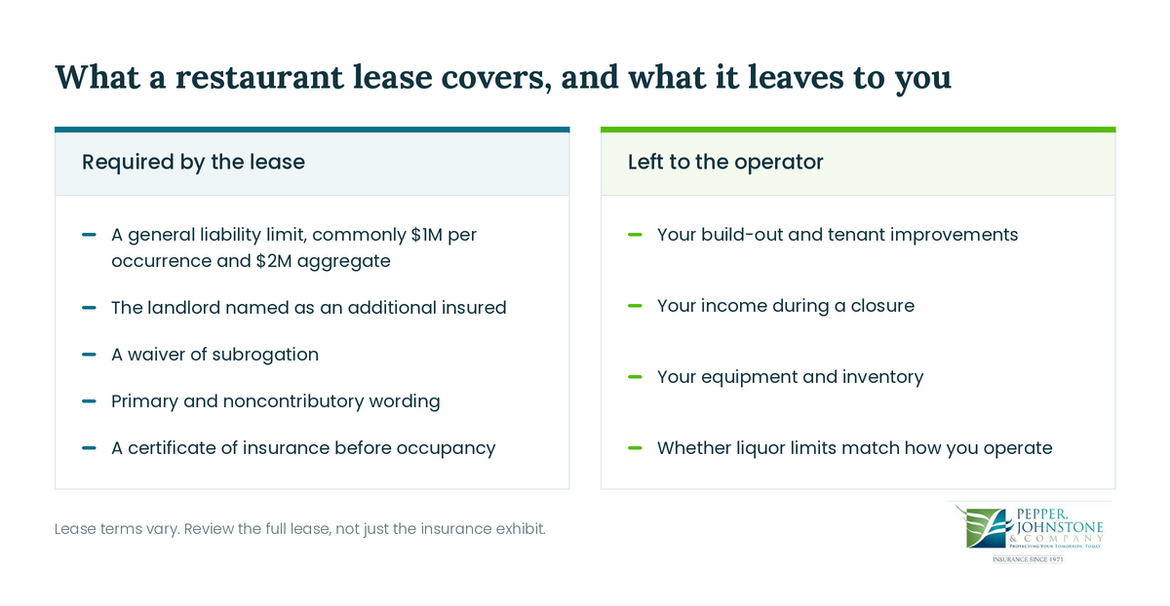
A typical restaurant lease insurance exhibit asks for a handful of specific things:
A general liability limit, commonly $1 million per occurrence and $2 million aggregate
The landlord named as an additional insured
A waiver of subrogation
Primary and noncontributory wording
A certificate delivered before occupancy as proof of insurance
Each of these provisions protects the landlord’s building and balance sheet. It says nothing about your build-out, your income during a closure, your equipment or whether your liquor limits match the way you actually operate.
Who Insures a Restaurant Build-Out?
The build-out phase is a common gap in a restaurant’s insurance program. In policy language, it’s called tenant improvements and betterments.
You paid for the hood system, the walk-in, the bar, the grease trap and the millwork. Those are permanent alterations to a building you don’t own, and you can’t take them with you when the lease ends. While the work is still in progress, that exposure belongs to builder's risk, and improvements coverage picks up once the work is finished and in use.
From there, most leases transfer ownership of the build-out to the landlord at the end of the term. But that doesn’t help you while you’re still operating, because you’re the one who paid for it and the one who has to replace it after a loss.
Make sure to read the lease provision and confirm which party is insuring the build-out.
Why Your Insurance Agent Should Read the Whole Lease
Indemnification language, casualty provisions, rent abatement and repair obligations all change the insurance analysis. A lease can obligate a tenant to restore a building they don’t own or to keep paying rent through a closure they didn’t cause.
An independent insurance agent who reads the full lease before coverage is bound can catch a requirement your policy doesn't currently meet. A quoting portal only sees the coverage you asked for.
Commercial Property Insurance for Restaurants: Risks in the Kitchen
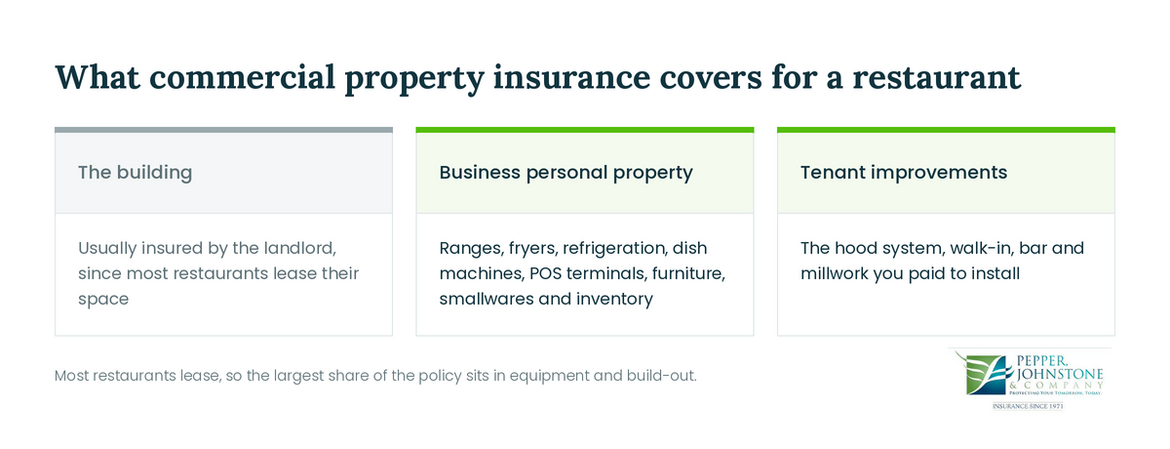
On average, 7,400+ structure fires are reported in eating and drinking establishments every year, costing more than $165 million in direct property damage. Commercial property insurance is what pays to rebuild afterward. It covers three categories: the building if you own it, your business's personal property and the improvements you made to a space you lease.
Business personal property is the bulk of it for most restaurants: ranges, fryers, refrigeration, dish machines, POS terminals, furniture, smallwares and food inventory. The building is often someone else's problem entirely, since most restaurants lease.
Of course, fire is the peril operators think about, but it isn’t the only one commercial property covers. Water damage from a failed supply line, theft, vandalism, wind and hail all sit under the same coverage.
Equipment Breakdown Coverage for Restaurant Kitchens
Property coverage responds to damage from an outside cause. Something like a walk-in compressor that simply fails doesn’t count. That’s a mechanical breakdown, and standard property forms treat it as excluded.
Equipment breakdown coverage comes in here, added by endorsement or through a business owner's policy. Spoilage is commonly available under the same endorsement, which is an option worth considering because the compressor failure and the $9,000 in product it ruins are two separate losses.
Spoilage sublimits are often set at a few thousand dollars and never revisited. Check yours against what is actually in the walk-in on any given Friday.
General Liability Insurance for Restaurants: Claims That Start in the Dining Room
General liability insurance protects your business from third-party bodily injury and property damage claims. These are situations like a guest slipping and falling on tile near the server station, a hot plate burning a customer, a fixture coming loose over a four-top or even water from your dish pit damaging the tenant space next door.
Claims arising from foodborne illness cases land here, too. When a guest alleges your food made them sick, defense costs begin accruing whether or not their allegation holds up. In fact, research shows that the
cost of a foodborne illness event can range from the thousands to the millions in lost revenue and legal fees.
The Assault and Battery Exclusion in Restaurant Liability Coverage
Insurance companies writing hospitality insurance policies frequently attach an assault and battery exclusion by endorsement. It isn’t part of standard general liability, so its presence depends entirely on which carrier wrote your policy and how they classified your operation.
If you employ door staff, host live music or serve past midnight, you’ll need to ask whether that exclusion is present, bought back by endorsement or capped at a sublimit below your primary limit. Most operators only discover the answer after an incident.
Liquor Liability Insurance: Why General Liability Isn’t Enough
The standard commercial general liability form contains a liquor liability exclusion that applies to anyone in the business of manufacturing, distributing, selling, serving or furnishing alcoholic beverages. A restaurant that sells or serves alcohol falls into that category. That means liquor liability has to be written as a separate policy or added by endorsement.
The details will vary considerably based on your:
Percentage of receipts that come from alcohol
Closing hours (before or after midnight)
Entertainment and dance floor offerings
Security staffing
Documented server training
That last point is important. Several states offer incentives for participating in beverage service training programs, including
a defense in dram shop actions and discounts on liquor liability insurance.
How Dram Shop Laws Affect Restaurant and Bar Insurance
Most states impose some form of commercial host liability, commonly called dram shop liability. In essence, these laws allow people to sue businesses for serving them alcohol under certain circumstances. For example, an intoxicated customer leaves your restaurant, and they go on to harm themselves or others.
The standards vary considerably throughout the nation and often change. But in insurance terms, they can affect where your policy will come from. Insurance carriers file their rates with each state, and those filings assume a fairly standard restaurant. A place doing most of its revenue at the bar until 2 a.m. with a dance floor and door staff is considered riskier, so many carriers decline it outright.
Your business is still insurable; it just moves to what the industry calls surplus lines, a market for risks that fall outside standard rate filings. Reaching those markets takes an agency with access to them. An agent working with a single carrier has one answer to give you, while an independent insurance agent can work to find the right placement across multiple options.
Business Income Insurance for Restaurants: What a Closed Kitchen Costs
A restaurant closed for six weeks after a kitchen fire still has to pay rent, insurance, debt service and the salaried people it can’t afford to lose. Business income insurance is calculated based on net income plus continuing normal operating expenses, measured over the restoration period until the property is repaired or replaced.
Of course, a dining room that has been closed for two months doesn’t typically return to full sales on reopening day. An extended period of indemnity endorsement can cover the ramp. Our breakdown of
how business income insurance coverage is calculated walks through the mechanics.
Additional Endorsements to Consider for Restaurant Closures That Aren’t Fires
Utility service interruption responds when a power failure spoils inventory and closes the doors.
Civil authority responds when access is blocked by an incident nearby.
Dependent property responds when a single-source supplier or an anchor co-tenant goes down.
Workers’ Comp Insurance for Restaurants: Burns, Cuts and Falls
Employee injuries are a class of their own, especially in industries where exposure is in the job itself: fryer oil, sheet pans coming out of 450° ovens, boning knives, wet tile, ice, repetitive lifting and a high turnover workforce—to name a few.
Workers’ compensation insurance covers medical bills and wage replacement for those injuries and, in most states, removes the employee’s right to sue the employer over them.
Workers’ Comp Requirements by State and Who Counts as an Employee
Requirements vary by state, usually by employee count, and may not align perfectly with IRS classifications for tax purposes. That means someone hired as a seasonal or 1099 worker may still need to be covered, depending on where you work. Restaurants with locations in multiple states must comply with the workers’ comp laws of each state in which they operate.
Check out our recent
guide on workers’ compensation requirements by state for more details.
Commercial Auto Insurance for Restaurant Delivery and Catering
Commercial auto insurance covers vehicles the restaurant owns, leases or uses for business. Delivery vehicles, catering vans or trucks that run to the produce supplier all count. Personal auto policies exclude business use, so an owned delivery vehicle has to be scheduled on a commercial policy before it leaves the lot.
Catering also changes your risk profile. Alcohol served off your licensed premises, venue contracts requiring additional insured status at specific limits, and equipment in transit can all put you outside of what standard policies cover. In these cases, it’s crucial to have someone on your side who can assess each exposure you face and help you find the right coverage for total peace of mind.
Hired and Non-Owned Auto Coverage for Restaurants
If an employee uses their own car to pick up an emergency order of produce, they’re on restaurant business, and their personal policy isn’t likely to cover any claims that may arise from an accident.
Hired and non-owned auto liability addresses this problem. It’s inexpensive relative to the exposure and frequently absent from restaurant programs.
Hospitality Insurance Lines Restaurants Add Later
Employment practices liability insurance, given the wage and hour, scheduling and harassment claims common to this industry
Cyber liability insurance, given the payment card environment running through your point-of-sale system
Commercial umbrella insurance to extend coverage above general liability, liquor liability and auto, which is critical for serious dram shop claims.
Building a Restaurant Insurance Program That Closes the Gaps
Every insurance requirement handed to a restaurant at opening comes from a party protecting its own position. The landlord protects the building, the lender protects the loan and the state protects injured workers and third parties.
No one’s protecting your build-out, your income or your personal exposure. Unless you work with an independent insurance agent who can build a program as one structure that covers everything your business realistically faces.
A handful of policies bought from one big-name carrier will have gaps at the seams, and restaurant claims land in exactly those seams. Building the program as one structure is what closes them.
Review Your Restaurant Insurance Before You Sign
If you’re opening a location, adding delivery or catering or renewing coverage without a clear picture of what changed, a coverage review is well worth the time.
Pepper, Johnstone & Company can review the lease and the policy together, then build the program around how your restaurant actually operates.
Request a quote online or call
866-381-5821 to talk it through with an advisor.