

TL;DR: Workers' compensation covers people, not companies. Whether any given worker is covered depends on how their state classifies them and where they physically work, which is why a small business can be fully compliant for its headquarters and uninsured for its subcontractors, remote employees or owners.
A nine-person HVAC company and a six-person accounting firm can have the same workers’ compensation problem for completely different reasons.
The HVAC company subcontracts overflow installs to two crews it pays on 1099s. The accounting firm has a bookkeeper who moved across a state line last year and kept working. Both businesses carry a policy, and neither policy covers everyone doing the work.
Too often, workers’ comp insurance for small businesses gets treated as a single yes-or-no decision. In practice, it’s a series of separate decisions person by person, and a company can be fully compliant for one group while carrying uninsured exposure for another.
But you might miss that fact until an annual premium audit comes around, or worse, when someone gets hurt. By then, the correction is retroactive. That’s why understanding which people your policy reaches is one of the more consequential parts of
business insurance and one of the easiest to get wrong.
Quick Facts: Workers’ Comp Insurance Requirements by State
State coverage triggers range from the first employee to five or more, and part-time, seasonal and temporary workers usually count toward the threshold.
Paying a worker on a 1099 doesn’t remove their status as employees because states apply their own classification tests and several presume a worker is an employee.
Workers’ compensation obligations attach in the state where the work is physically performed, not the state where the company is registered or headquartered.
An owner or officer exemption removes that individual from the policy and leaves the business’s obligation to cover its employees fully intact.
Carrying required coverage preserves the exclusive remedy rule, which bars most employee injury or illness lawsuits against the employer.
Who Qualifies for Workers’ Comp?
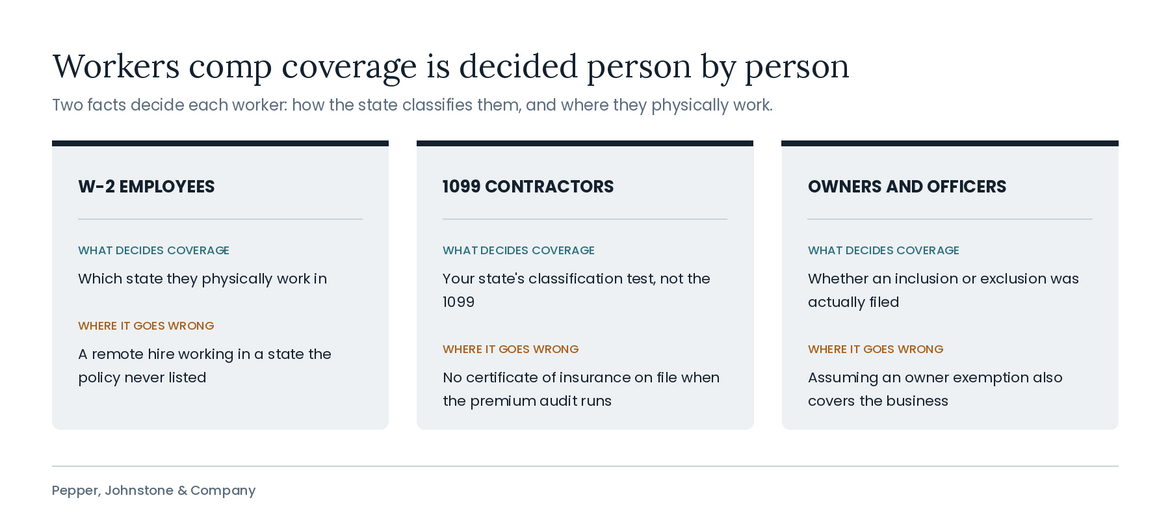
Workers’ compensation covers medical care, lost wages, ongoing occupational or physical therapy and death benefits after on-the-job injuries. It covers individual people, not the company, and whether they need to be covered depends on two facts:
How that person is classified under the law of the state involved
Which state they physically perform the work in
A single policy can cover both correctly for your office staff but overlook everyone else. That’s why, when it’s time to build a policy, you need to have your roster in mind more than just the workers' compensation premiums themselves.
List every person who performs work for the company. Then sort them into three groups: W-2 employees, workers paid on 1099s, and owners or officers. Each group involves a different risk.
If you need a refresher on the mechanics of the coverage itself, our guide to how workers’ comp coverage works explains benefits, claims handling and employers’ liability. In this article, we’ll talk about who falls inside the policy and who doesn't.
Is Workers' Comp Insurance Required by Law?
In nearly every state, yes, once you have employees. Four factors can set the obligation in motion.
Your first employee: In many states, coverage is required the day you put one person on payroll. Revenue, profitability, and years in business have nothing to do with it.
A certain number of employees: A smaller group of states sets the bar at three, four or five employees.
An industry carve-out: Construction and agriculture are commonly treated differently, often with a one-employee threshold, while other industries get more leeway. Some states apply separate rules to domestic and seasonal workers.
A contract you signed: A general contractor’s subcontract, a landlord’s lease or a government contract can require proof of coverage regardless of what state law says.
Which States Require Workers’ Comp for Small Businesses?
Most states require coverage with the first employee, including part-time workers. A smaller group sets the threshold at three, four or five, and Texas leaves it optional for most private employers.
State thresholds change through legislation, but as of 2026, here are the workers’ comp insurance requirements by state, including notable exceptions:
Workers' Compensation Coverage Thresholds by State
| State | General Threshold |
|---|---|
| Alabama | 5 or more employees |
| Florida | 4 or more employees non-construction, 1 or more construction; 6 or more regular employees and/or 12 or more seasonal employees agriculture |
| Georgia | 3 or more employees |
| Kansas | When gross payroll exceeds $20,000 |
| Mississippi | 5 or more regular employees |
| Missouri | 5 or more employees non-construction, 1 or more construction |
| New Mexico | 3 or more employees non-construction, 1 or more construction |
| North Carolina | 3 or more employees |
| South Carolina | 4 or more employees |
| Tennessee | 5 or more employees generally, 1 or more in construction or coal mining |
| Texas | Optional for most private employers |
| Virginia | 2 or more employees |
| Wisconsin | 3 or more employees |
| All other states | 1 or more employees |
Thresholds current as of August 2026. State requirements change through legislation. Confirm with the applicable state agency before relying on this table.
Which States Require Workers’ Comp from a State Fund?
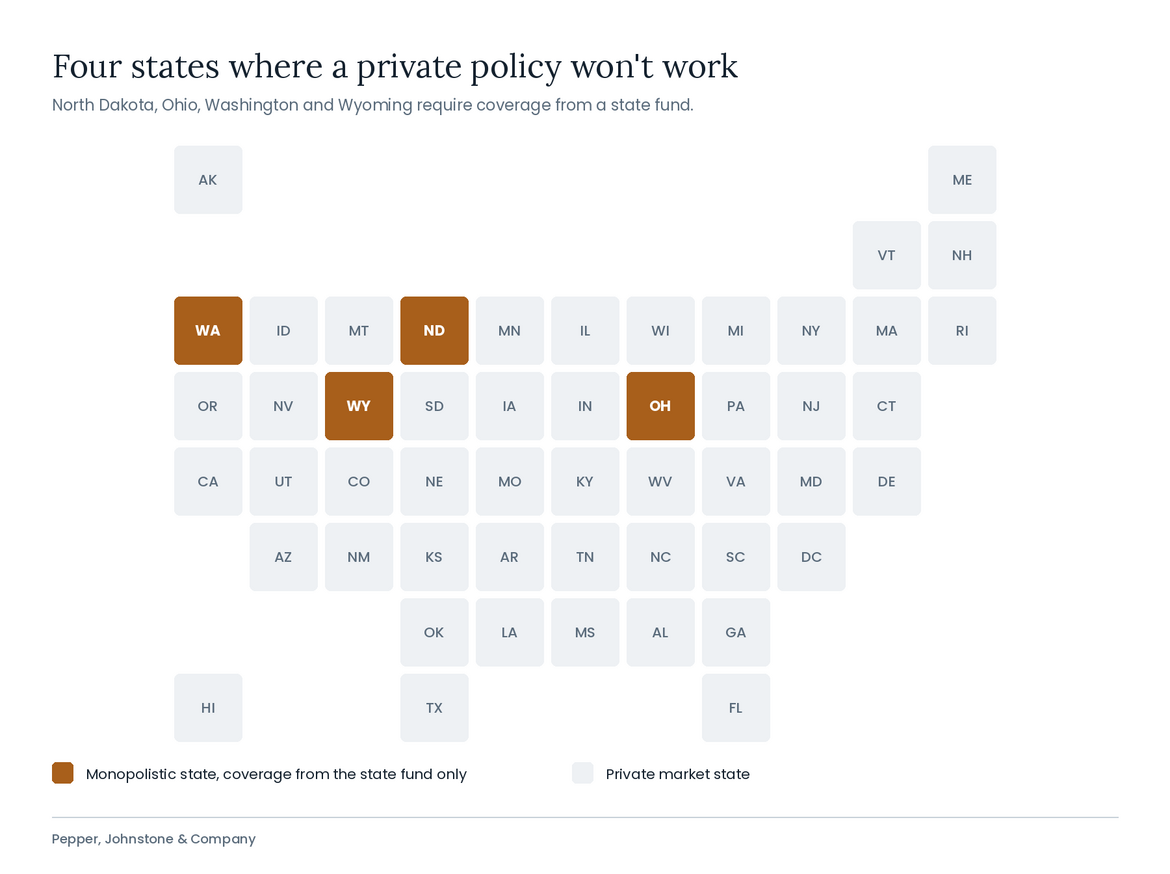
North Dakota, Ohio, Washington and Wyoming operate monopolistic systems, which means coverage has to be purchased from the state fund and can’t be added to a private policy.
Can a Contract Require Workers’ Comp Before State Law Does?
Yes, and for smaller businesses, it may very well be the first thing that triggers an obligation. A three-person shop bidding as a subcontractor receives an insurance requirements exhibit, and workers’ compensation is right there on the list next to general liability. At that point, the requirement is contractual, and the job can’t start without a certificate of insurance showing coverage in place.
Pro Tip: Binding coverage under deadline pressure can produce a different program than you’d get by planning ahead. Companies in that position tend to accept whatever can be issued quickly at the minimum limits the contract will allow, but that approach can leave you dangerously exposed.
Who Counts Toward Your Employee Count?
More people than your payroll headcount suggests. Part-time employees generally count, and so do temporary and seasonal workers. Some states count unpaid interns, and several treat family members working in the business as employees unless a specific exemption is filed.
States also differ on how they measure. Some look at anyone employed on any day during the year, and others apply a regularly employed standard over a defined period. For example, Florida requires coverage for agricultural workers employed for more than 30 days.
Do You Need Workers’ Comp Insurance for 1099 Contractors?
Sometimes. A 1099 is a tax form rather than a determination of status, and a company can be correct for federal tax purposes and wrong for state workers’ compensation on the same person. Either the state or your own premium auditor can overrule how you’ve classified someone.
While most states don’t require businesses to cover properly classified 1099 workers, some have broad enough definitions of “worker” to effectively make it a requirement.
For example:
Florida requires construction industry businesses to cover all workers, including subcontractors and 1099 workers.
Pennsylvania considers all workers to be traditional employees unless proven otherwise under strict tests.
Ohio, one of several states with universal or near-universal definitions, applies workers’ comp rules to anyone performing labor if an employment relationship is found to exist.
What Is the ABC Test for Independent Contractors?
States apply their own tests to determine whether independent contractors are exempt from workers’ comp obligations. California, New Jersey and Massachusetts are among the states that use versions of an ABC test, which presumes a worker is an employee unless the hiring company satisfies every prong:
Control: The worker operates outside of the business’s control, meaning the company does not dictate when, where, or how the work is performed.
Core Business: The worker completes tasks that are not considered central to the business’s primary operating model
Independent Business: The worker is typically engaged in services of the same nature through an independently established trade or business.
If even one of these three prongs falls through, you are obligated to cover that person.
Why Are Contractor Payments Appearing on My Insurance Premium Audit?
Because payments to uninsured subcontractors and 1099 workers are generally pulled into your payroll base unless you can produce a valid certificate of insurance for each one.
When this happens, it’s a documentation failure—an expensive one that results in a retroactive premium bill. Collecting certificates at engagement costs nothing and protects you from having to reconstruct them a year later during an audit.
An exposure of this kind is more serious if someone gets hurt. When a worker is later determined to have been misclassified, the claim is generally not covered by the employer’s policy, which leaves the business paying the loss directly while also facing state penalties.
If you regularly hire outside crews, our discussion of
whether your contractors are covered walks through what to collect and when.
Does Workers’ Comp Cover Remote Employees in Other States?

Only in the states your policy lists. Hiring across state lines creates a workers' compensation obligation in each state where someone works, and your state of registration is moot.
A company incorporated in Georgia but operating out of Alabama, with engineers in Ohio, Florida and Colorado has employer duties in four states. And without the right advisor, they may only have a policy that names one.
Does My Policy Cover Employees in States It Doesn’t List?
Usually not. Every workers’ compensation policy has an Information Page, where Item 3.A lists the states where the policy provides primary coverage. Those are the states the insurance company has rated and priced.
Item 3.C, Other States Insurance, is the backstop. It typically applies where an employee is working temporarily in a state not listed in 3.A and where the employer was not required by that state’s law to carry coverage there.
A permanent remote employee doesn’t fit that description. They work in that state on an ongoing basis, so the state will require you to insure locally. If you hire a worker in a monopolistic state (North Dakota, Ohio, Washington, Wyoming), you’ll have to open a separate state fund account before that person starts work.
Does a PEO Handle Multi-State Workers’ Comp?
A PEO usually handles the administration of workers’ comp but not the obligation.
A PEO, or Professional Employer Organization, co-employs your staff and typically carries the workers’ compensation benefits, which is why owners assume the question is settled. Your business generally remains the common-law employer, so the state’s recourse can still run to you if a filing is missed. Ask which entity holds the workers' compensation account in each state, and get the answer in writing.
Adding states is also where the choice of carrier comes into play. A carrier can only write in states where it's admitted and has filed rates, and a regional carrier that fits your business well at home may have no authority in the state you just hired into.
Pepper, Johnstone & Company represents
multiple carriers and reviews the Item 3.A schedule against where employees physically work. We work with you to explore your actual risk profile and build policies that truly protect your business.
Are Owners and Officers Exempt from Workers’ Comp?
Not automatically. In most states, corporate officers are included under the policy by default and have to file a specific election with the carrier or the state board to be left off. Conversely, sole proprietors and partners are generally excluded by default, with the option to elect in. However, states differ on the minimum ownership percentage required, which officer titles qualify and how many officers may be excluded.
Several states also apply a substance test rather than accepting a title.
Washington, for example, requires that an officer be voluntarily elected or appointed in accordance with the corporate bylaws, hold stock issued in their own name and exercise substantial control in the daily management of the corporation.
What Happens If You Don’t Carry Required Workers’ Comp?
You lose what’s called exclusive remedy. Workers’ compensation is a trade in which injured employees receive quick medical and wage benefits without having to prove the employer was at fault, and in return, they generally give up the right to sue the employer.
That protection only exists if you carry the coverage the state requires. Without it, an injured worker can pursue the business in civil court for full damages, including categories that workers’ compensation never pays, like pain and suffering.
These claims are seldom small enough for a small business to take on easily. The average workers’ compensation claim was $47,316 for accidents occurring in 2022 and 2023, and bearing the brunt of a single uncovered claim of that size is difficult to recover from.
Then there are the penalties that come on top of that. For example, in
Illinois, an employer that knowingly and willfully fails to obtain coverage may be fined up to $500 for every day of noncompliance with a $10,000 minimum, and corporate officers can be held personally liable for the amounts due.
What Happens if You Opt Out in Texas?
Not only are you wide open to legal recourse for injuries, but three common legal defenses also disappear. Under Texas Labor Code Section 406.033, an employer without workers' compensation coverage cannot argue that the employee was contributorily negligent, that the employee assumed the risk or that a fellow employee caused the injury. The employer isn't defenseless, but it puts all the more risk exposure on them.
Non-subscribers also take on ongoing paperwork. They must file an annual notice with the Division of Workers' Compensation, post notice of non-coverage at the workplace, tell new hires in writing and report injuries once they reach five or more non-exempt employees.
Check the Roster Before You Buy the Policy
Every mechanism in this article costs almost nothing to address before a hire but a great deal to address after a claim.
Adding a state to Item 3.A is paperwork, and collecting a certificate of insurance from a subcontractor takes one email. Filing an owner exemption correctly just takes a form. Left undone, all of them become a retroactive premium bill, an uncovered claim or a personal liability question once an accident happens.
Businesses that get this right stop treating workers’ compensation solely as an annual renewal item and start treating it as a hiring checklist item. Every new employee, every subcontractor engagement and every relocation is a moment to ask whether the policy still covers everyone it needs to. An
annual insurance review catches what’s left.
Review Your Coverage with an Independent Insurance Agent
If you’re hiring across state lines, paying subcontractors regularly or are unsure whether your owners were correctly included or excluded, that’s a conversation to have before an audit or claim forces your hand.
Pepper, Johnstone & Company
works with small and midsize businesses to structure workers’ compensation programs correctly around who is doing the work and where.
Request a quote online or call
866-381-5821 to speak with an advisor.