

If your software or IT work costs a client money, there’s a good chance they’re going to turn around and expect you to pay for it—and then some. That’s the exact type of scenario tech E&O insurance was made for.
Tech E&O claims arise from ordinary work all the time. Say a routine update to your billing platform causes invoices to be miscalculated, even slightly, and a client overbills its customers for two months. The refunds, cleanup and lost business can all land in a claim against you.
And your general liability policy? It likely won’t help in a case like this. Here’s what tech E&O covers, where cyber insurance takes over and how your client contracts shape what you’re actually protected for.
Technology Errors and Omissions Insurance Coverage at a Glance
Tech E&O insurance covers legal costs and damages when a client claims your technology products or services caused them financial harm.
Cyber liability insurance covers data breaches and your own incident costs. Tech E&O covers claims that your work caused a client's loss.
Many policies exclude liability you took on by contract, so SLA credits and broad indemnities deserve review before you sign.
Tech E&O is typically claims-made, which makes continuous coverage and your retroactive date as important as your limit.
What Tech E&O Insurance Covers
Tech E&O insurance, a specialized form of errors and omissions coverage, responds when a client claims your technology products or technology services caused them financial harm. That usually means one of two things: a product that didn't perform as promised or an error in the services you delivered.
The policy covers legal defense plus settlements or judgments tied to allegations of professional negligence. Legal costs often arrive long before anyone decides who was at fault, so much of the practical value lies in that defense coverage.
General liability typically won't step in for issues like this. It's built for bodily injury and property damage, and a client's system going down for a week produces neither.
Who Needs Technology Errors and Omissions Coverage?
Any business selling information technology work to other businesses carries this exposure, including SaaS platforms, custom software developers, IT consultants and managed service providers (MSPs). Our guide to insurance for SaaS companies shows where tech E&O fits in a broader technology insurance program.
MSPs carry unique risks because they hold administrative access to many client environments, so one misconfiguration can reach several accounts at once. Technology professionals who advise rather than build face the same professional services exposure covered in our guide to E&O for consultants.

How Tech E&O Claims Start
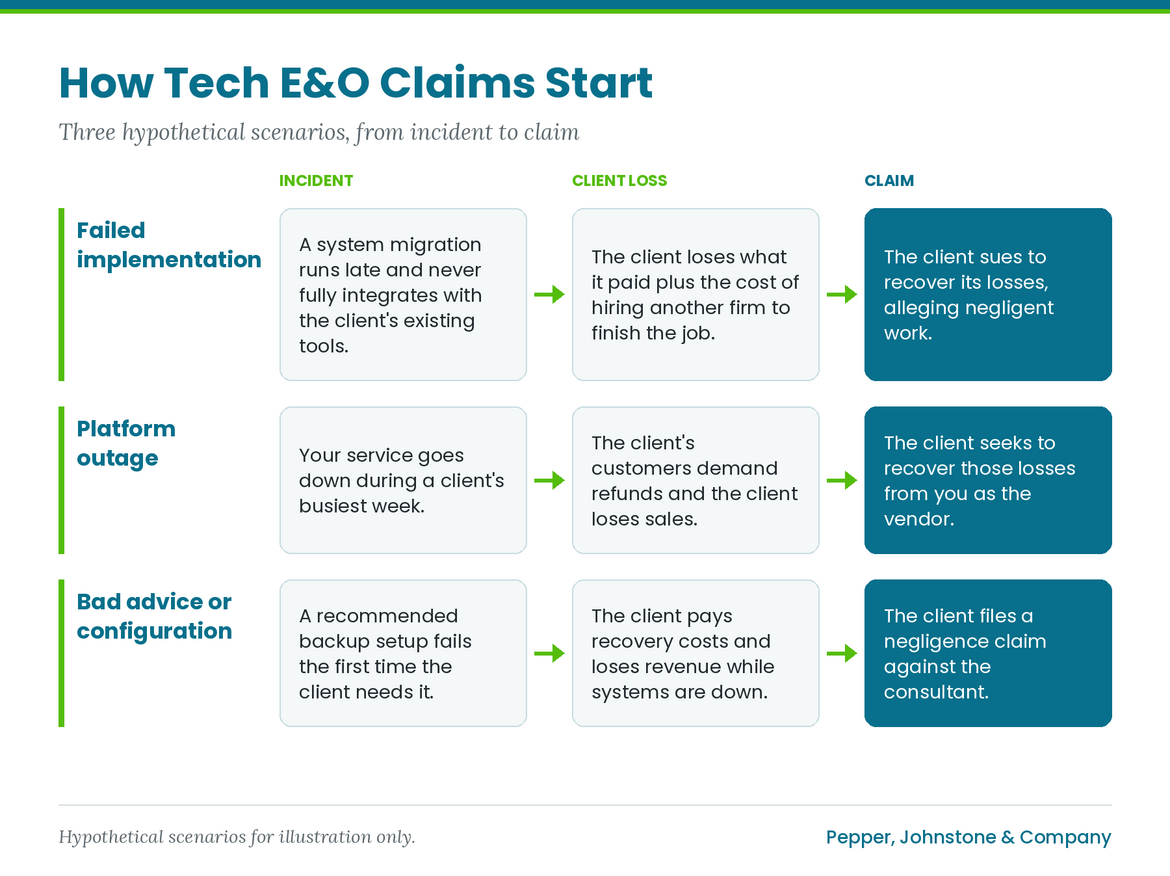
Most claims trace back to ordinary technology errors made under pressure: think tight project deadlines, complex integrations and releases that have to ship on schedule. A few common scenarios come up again and again.
Failed implementations: A development firm falls behind on a system migration, then delivers software that never fully integrates with the client's existing tools. The client sues to recover what it paid plus the cost of hiring someone else to finish the job.
Platform outages: Your service goes down during a client's busiest week. When customers file complaints and demand refunds from your client, those losses can roll uphill to you.
Bad advice or configuration: An IT consultant recommends a backup setup that fails the first time the client needs it. The client's recovery costs and lost revenue become the basis of a negligence claim.
The financial consequences of any scenario like this scale quickly. In a 2025 survey by Uptime Institute, 57% of respondents said their most recent major outage cost more than $100,000, and one in five reported costs above $1 million. Those figures reflect the operator's own costs, before any client claim.
Tech E&O vs. Cyber Insurance: Which Policy Do I Need?
Technology companies that handle sensitive customer data face two separate exposures, and the policies that cover them are easy to confuse. Cyber insurance protects your business when an attack or breach hits you. Tech E&O protects you when a client says your work caused their loss.
Cyber liability insurance covers data breaches and your own incident costs. Its first-party coverage typically pays for forensics, notification, data recovery and business interruption when an attack takes your own systems offline.
That cyber risk comes with a real price tag, too. IBM's 2026 study of 602 breached organizations put the global average breach cost at $4.99 million.
A single incident can raise both exposures. If a misconfiguration you made exposes client data, breach response and privacy liability fall under cyber coverage, while the allegation that your services were negligent falls under tech E&O.
That overlap is why many carriers write E&O and cyber together. Travelers' technology form, for example, offers insuring agreements for technology errors and omissions alongside privacy and security coverage. Whether those parts share a single limit should be settled before a claim arrives.
| Incident | Who's Harmed | Tech E&O | Cyber |
|---|---|---|---|
| Service outage | Your client and its customers | Likely responds when a client claims your service failure caused its losses | May respond if a cyberattack caused the outage, including your own downtime costs |
| Calculation or data error | Your client and its customers | Likely responds; this is a core tech E&O claim | Generally doesn't apply without a breach or attack |
| Failed implementation | Your client | Likely responds to negligence allegations; contract claims depend on wording | Generally doesn't apply |
| Client data exposed by your error | Your client and the people whose data was exposed | May respond to the client's claim that your services were negligent | Likely responds to breach response costs and privacy liability |
| Ransomware on your own systems | Your business first, then clients if service is disrupted | May respond to client claims tied to the disruption, depending on the form | Likely responds to forensics, restoration, business interruption and related client claims |
General guidance only. How a policy responds depends on its wording and the facts of each claim. Many carriers combine tech E&O and cyber on a single form.
Contract Terms That Can Limit Your Tech E&O Coverage
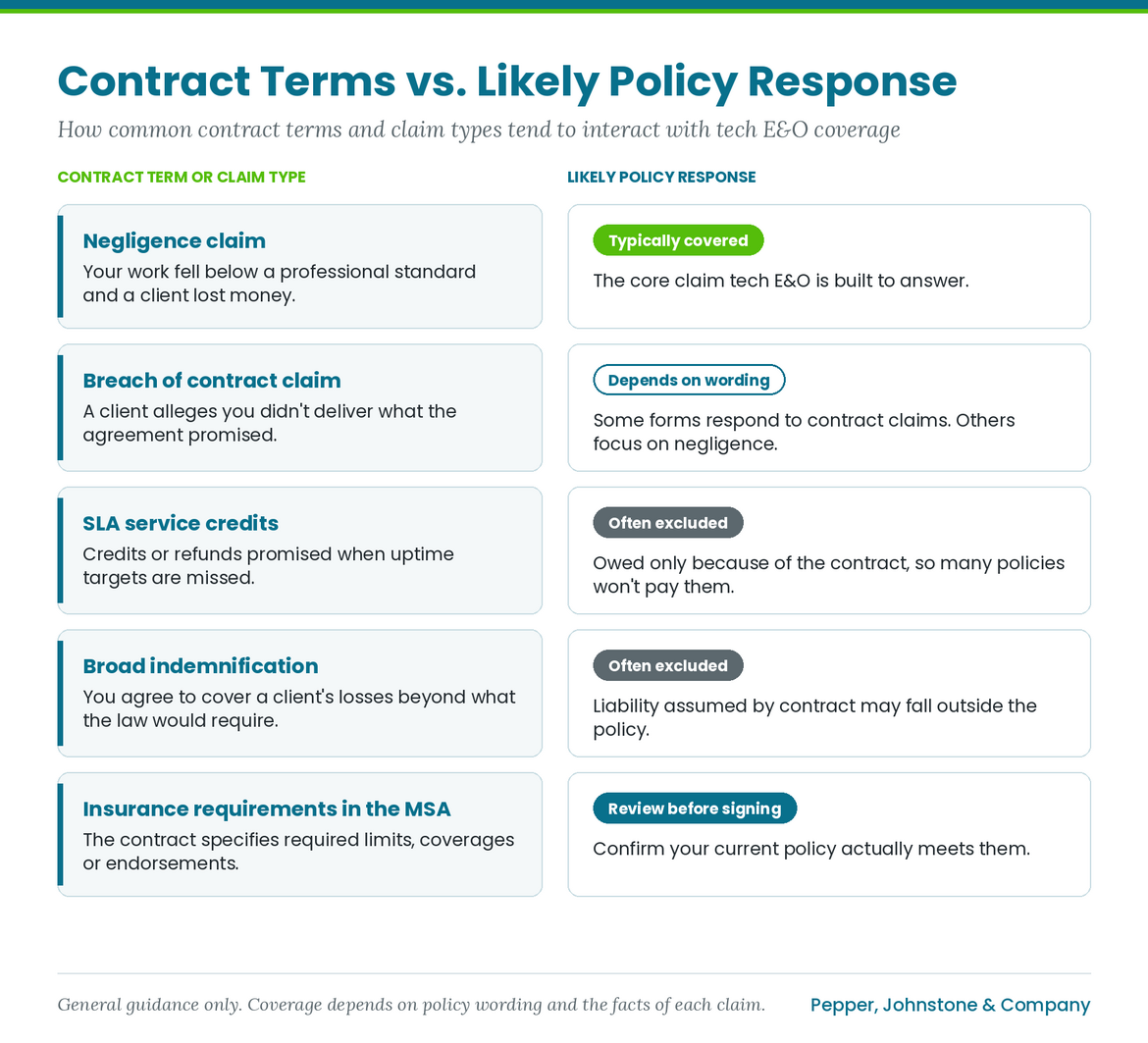
Your Master Service Agreements (MSAs) and Service Level Agreements (SLAs) define your real exposure, and your policy language may not match them. Depending on the wording, an E&O policy may respond to negligence claims, breach of contract claims or both. A single lawsuit can allege both at once.
Many policies also exclude contractual obligations you agreed to beyond what the law would impose on its own. In plain terms, if the liability exists only because you promised it in a contract, the policy may not pay for it.
This usually means something like uptime guarantees, service credits and broad indemnification clauses. A client sues over a covered negligence claim, while the SLA credit or indemnity you promised may sit outside the policy.
An independent insurance advisor who reads your client contracts against the policy form before you sign can flag those mismatches while they're still negotiable. Without that review, a policy can match exactly what you requested and still miss what your contracts require.
How Much Tech E&O Coverage Do You Need?

Set limits against your largest client contract and the most expensive failure you could realistically cause. Contract minimums are at most a baseline. One outage can produce claims from several clients against the same aggregate limit.
And don't forget that policy structure matters as much as the number. Software E&O is typically written on a claims-made basis, so the policy that kicks in is the one that's active when the claim is made, and your retroactive date sets how far back past work is covered. Our explainer on claims-made policies walks through how gaps like that can happen.
Carrier appetite and policy forms vary widely, including how each defines technology services and treats AI-related liability. A narrow definition can leave a product you launched after your last renewal outside the policy. Pepper, Johnstone & Company works with more than 60 insurance companies, which makes it possible to compare those definitions side by side.
Build Coverage Around the Contracts You Sign
A technology company's exposure lives in its contracts: the uptime it promises, the data it holds and the indemnities it signs. Coverage built without reading them is a guess. Treat your E&O and cyber policies as the other half of every client agreement and review them whenever those agreements change.
Review Your Tech E&O Program Against Your Contracts
If you're signing larger client contracts, adding services or checking whether your E&O and cyber coverage fit together, Pepper, Johnstone & Company can compare policy forms across multiple carriers and read them against the agreements you've signed. Request a quote online or call 866-381-5821 to speak with an advisor.